Back to blog
How to Hire a Web Scraping Specialist for Custom Data Collection


Key Takeaways
- Freelance platforms is a good choice for fast, bounded jobs; tech communities for technically-verifiable candidates; and managed providers for business-critical, recurring data needs.
- Candidates should be evaluating against services provided (e.g. ongoing maintenance), technical skills, and soft skills (communicative especially).
- Relying on a single freelancer for critical data is a risk for long-term plans, in contrast to a team-based provider.
Usually, when companies hire web scraping specialists, they write job posts like this:
“Experienced web scraping developer needed to build reliable, scalable scraping solutions. Must handle dynamic content, JavaScript-rendered pages, and complex site structures. Deliver clean, structured data on a schedule, with proper parsing and monitoring. Looking for a long-term developer if the initial project goes well.“
That last line is the most painful topic. The listing asks for someone who can write a working scraper (Python, BeautifulSoup or Scrapy, Selenium or Playwright), comfortable with dynamic content and anti-bot quirks. But can this person still be reachable and reliable six months from now, when the target site redesigns its layout or adds a new detection layer? And how to protect your business processes from being paused alongside the flow of data?
This guide covers the real hiring options, what to check before signing anyone, and where a managed provider makes more sense than a freelancer.
Where to Find Web Scraping Developers: The Key Options
When hiring web scraping specialists for your project, you find three paths that lead to a working scraper, and each fits a different situation.
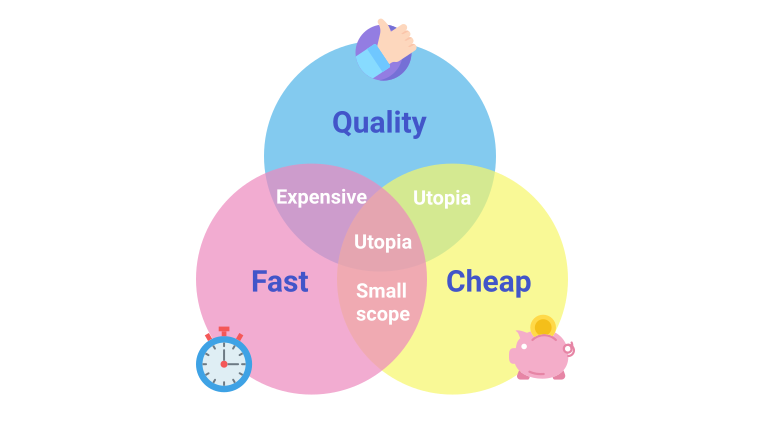
Freelance Platforms (Upwork, Fiverr, and Similar)
Freelance marketplaces are the fastest way to hire data scraping specialists for a defined, bounded task. Post a job, review proposals, pick a candidate, and work usually starts within a day or two.
However, the problem is verification. Portfolios on these platforms are self-reported, reviews on newer profiles can be thin, and a freelancer’s actual experience with anti-bot systems or JavaScript-heavy sites is hard to confirm. Price also varies widely. Some define a fair estimate of the work, others define a bid lower to win the job and figure out (or not) the difficulty later.
Tech Communities (GitHub, Reddit, Discord, Stack Overflow)
Developer communities are where many experienced scraping engineers are visible through actual code, and this is brilliant. An active user in r/webscraping or a maintainer of a popular scraping library on GitHub has a public track record you can inspect directly through commit history, issue discussions, and recommendations of other scraping experts.
Finding the right person this way takes longer than posting a job listing, and there’s no built-in payment protection or contract structure, unlike freelance platforms. This route works best when you or your team already have some technical judgment to evaluate the candidate.
Managed Service Providers
A managed provider takes on the scraping work as a service: a team builds the scraper, monitors it, and fixes it when the target site changes. This costs more per month than a single freelance contract, but it removes the risk of sudden end of cooperation. For data that’s core to your product that tradeoff is usually worth it.
If a full custom build feels premature for where you’re at, this guide on how to choose a data scraping vendor covers the evaluation process in more depth.
For a closer look at how different providers in this space compare, see this breakdown of the best web scraping services on the market.
How to Hire Web Scraping Developers: A Step-by-Step Guide
Below is a step-by-step guide that structures and explains all the stages of hiring scraper experts:
Step 1: Define Your Data Scraping Needs First
Before evaluating anyone, write down exactly what you need: sites, fields, how often, in what format, and point of delivery. Such brief helps to compare candidates against each other.
Startups that skip this step often end up with a scraper that technically works but doesn’t fit the pipeline (wrong format, wrong frequency, etc.). Noticing these issues too late requires maintenance and, therefore, money.
Step 2: Map Out Tech Requirements and Soft Skills
Based on the annual evaluation of customer satisfaction in DataOx, we found that every third client finds communication as one of the top factors in choosing a scraping specialist. If you are looking for a long-term partner, an ability to communicate clearly, politely, and timely, explain nuances both technically and simply, always distinguish experts among others.
However, web scraping is a specialized discipline. Someone who’s a capable general web developer is not automatically experienced with real-world data extraction.
Look for direct experience with:
- JavaScript-rendered websites
- Browser automation (Playwright, Selenium, Puppeteer)
- APIs and network request inspection
- Pagination and complex site navigation
- Authentication and session handling
- Proxy infrastructure
- Rate limiting and anti-bot systems
- Data parsing and normalization
- Monitoring and scraper maintenance
More than any single skill on this list, ask whether the candidate has worked with the specific type of source you need. For example, e-commerce catalogs are much easier to scrape than JavaScript-heavy travel booking site or a login-gated B2B platform.
Step 3: Conduct Background and Referral Checks
Ask for examples of scrapers built for sites with anti-bot protection comparable to your target. Now the industry is experiencing a spread of fraudulent candidates that generate almost all of their skill representation. Therefore, code examples with a brief of their results and thoughtful analysis of given answers from your side can guarantee that you talk to a real expert.
Where possible, talk to past clients directly rather than relying on written reviews alone. A five-minute call about their partnership tells you more than a star rating.
Step 4: Discuss Compliance and Security
Ask how the candidate approaches legal and compliance considerations, respecting robots.txt, avoiding personal data collection, and staying within a site’s terms of service. A candidate who has no answer here, or treats the question as irrelevant, demonstrates a suspicious signal.
Learn more about legal aspects of web scraping and what else represents suspicious signals here —> Is web scraping legal? Full Guide Before Scraping
Step 5: Agree on Delivery and Pricing
When can you mark a task as “done”? Specify data format, delivery schedule, acceptable error rate, and what happens if a source blocks the scraper mid-project.
Freelance pricing models vary, and each option shifts risks differently between you and the contractor. Pay close attention to each term of the contract: a fixed price with no clause for handling site changes puts all the ongoing risk on you after the contract ends.
Step 6: Start with a Pilot and Agree on Maintenance
Before committing to a large or long-term engagement, agree on a smaller pilot — one source, a limited data set, a short timeline. This tests both technical fit and how the person communicates when they face relevant obstacles.
Maintenance deserves its own explicit conversation. Ask directly: is ongoing maintenance included, billed separately, or not offered at all? It’s much cheaper to address in the contract than to discover after the fact.
Best Practices for Hiring Web Scraping Developers
The hiring process outlined above will filter out most inappropriate candidates, but a few principles are worth keeping in mind before, during, and after you’ve made a decision.
- Evaluate reliability. Building a scraper is only part of the job. Websites change their layouts, add new technical barriers, and it affects scrapers’ work.
- Weigh the risk of relying on one freelancer. Speaking of one hired person, a human factor can change any plans. A data provider spreads that risk across the team and gives you a point of accountability.
- Check scalability before you need it. If you expect your data needs to grow, ask candidates directly how they’d handle more sources, higher volume, and more frequent extraction.
Red flags worth worrying about
No single red flag automatically disqualifies a candidate, but more than one together is a reason to slow down.
- Vague or evasive answers about anti-bot handling.
- No mention of monitoring or maintenance.
- Pricing that’s off-market in either direction.
- No answer for what happens if a source blocks the scraper.
- Hesitation to provide a reference or a past example.
- Portfolio or code samples that feel generic, copy-pasted, or AI-generated.
- Overpromising on speed or reliability.
- No scope, pricing, or maintenance terms in the contract (verbal agreements instead).
Remember, a great developer might have a thin portfolio if they’re newer to freelancing, and non-market quotes can happen because a candidate is not familiar with average rates.
Hire a Reliable Web Scraping Specialist from DataOx
For a one-time, low-stakes extraction job, the freelance and community covered above are often the right choice, there’s no need to bring in a managed provider for something you’ll only need once. But when scraping failures start costing you time you don’t have, or mistakes can surface on your clients’ side, that’s the point where a dedicated team starts to make sense.
DataOx has been building and maintaining web scraping infrastructure for over 10+ years, across sources ranging from product catalogs to sites with layered anti-bot protection. Projects come with monitoring and structural-change detection built in from the start. A site redesign gets caught and fixed as part of the service. Work is handled by a team rather than a single point of failure, which addresses the continuity risk covered above directly.
If you’re evaluating whether a managed provider fits your situation better than a freelancer, schedule a consultation to talk through the specific sources and volume you’re dealing with. There’s no obligation to move forward, but you’ll receive all the answers you’re looking for.
You can also check our web scraping services to learn more about the DataOx approach.

web scraping services
Get free consultation
How much does it cost to hire a web scraping specialist?
Freelance rates for scraping work range from $15-25/hour for simpler, low-protection sites up to $50-100+/hour for developers experienced with heavily protected or JavaScript-rendered sources. Managed providers typically price by project scope or as an ongoing monthly service, since the cost includes maintenance. You can evaluate the pricing of DataOx’s scraping services for your project.
Where to hire web scraping developers if I'm not technical myself?
If you can’t evaluate technical answers directly, the safest starting point is a managed provider like DataOx or experts from tech communities. Lean on references and past work of candidates; ask them to explain, in plain language, how they’d handle your specific request; are there any obstacles? You can also talk directly to past partnerships and ask them about cooperation experience.
How to hire web scraping developers for a business-critical, recurring data feed?
Treat this seriously from the start. Prioritize candidates or providers who offer monitoring, maintenance, and methods. If someone has won your trust, try to agree on a pilot project on one source, with clear success criteria before ongoing engagement. As a long-term data partner, DataOx can provide most of the data delivery schedules: monthly, weekly, daily, and even in real time.
What's the difference between hiring a freelancer and using a managed scraping service?
A freelancer is one person taking on defined tasks. In the context of scraping, they get paid for the portions of data delivered. A managed service like DataOx is a team with shared accountability, built-in monitoring, and continuity. Freelancers tend to be more cost-effective for small, bounded jobs; managed services tend to be more cost-effective for data-driven businesses.
Can I switch from a freelancer to a managed provider later without starting over?
Yes, especially if the original work was documented well enough. This is one more reason to ask about documentation and handoff terms before starting a freelance engagement.
Stay ahead with data insights
Subscribe to DataOx newsletter




get a free consultation
Fill out the form — we'll get back to you with options tailored to your needs.
what happens next
We review your goals and get in touch to clarify scope
Your privacy is a priority — NDA available upon request.
You receive a clear proposal with timeline, budget, and delivery format.
Once approved, we start building your data pipeline.


contact us
Let's find the best solution for your data needs.

get a free consultation
Fill out the form — we'll get back to you with options tailored to your needs.
what happens next
We review your goals and get in touch to clarify scope
Your privacy is a priority — NDA available upon request.
You receive a clear proposal with timeline, budget, and delivery format.
Once approved, we start building your data pipeline.
contact us
Let's find the best solution for your data needs.