Back to blog
Web Scraping Challenges: 8 Obstacles and How to Fix Them


Key Takeaways
- Core web scraping challenges divide into three categories: structural (site redesigns, inconsistent HTML across pages), technical (JavaScript rendering, dynamic content loading), and defensive (bot detection, CAPTCHA, IP blocking, browser fingerprinting, honeypot traps).
- Anti-bot detection is layered — enterprise protection from Cloudflare, Akamai, Imperva, DataDome, and PerimeterX combines IP reputation, fingerprinting, and behavioral analysis.
- Proxy type has to match the target’s protection level — datacenter IPs work for lightly protected sites, while residential or mobile IPs are usually required for enterprise-grade bot management.
- Data quality and duplicate data challenges are prevented with validation step before delivery.
As web scraping keeps getting more popular, more obstacles stand between a scraper and clean, usable data. Bots now make up over half of all internet traffic, and bad bots specifically account for around 37-40% of it, which explains why nearly every significant website invests in some form of bot detection today, and presents new web scraping challenges.
Below are challenges in web scraping that come up most often, and what actually works to solve each one.
Website Structure Changes and Inconsistent HTML
From time to time, websites go through structural changes or redesigns to improve user experience. This is a real challenge for scrapers built around specific page elements, even a minor change can silently break extraction. Such issues are resolved by constant monitoring and timely adjustments and set-ups.
On large sites with 1,000+ pages (big e-commerce platforms are the classic example) different pages often carry different HTML structures entirely. This usually happens because large sites accumulate old and new pages built by different development teams over years.
Solution: Scan the whole site to map where the coding differs, then adjust parsers accordingly for each pattern found.
JavaScript Rendering and Dynamic Content
Many of today’s websites load their real content after the initial page request, through JavaScript. Single-page applications, infinite scroll feeds, and dynamically rendered pricing are all common challenges in web scraping now. A scraper that only reads the raw HTML response will miss such data.
The standard fix is: a headless browser (Playwright, Selenium, or Puppeteer) that executes JavaScript the way a real browser would before the page content gets parsed. This adds overhead compared to a simple HTTP request, but it’s required for any site with a meaningfully dynamic content.
Common Web Scraping Challenges and Solutions: Anti-Scraping Techniques and Bot Detection
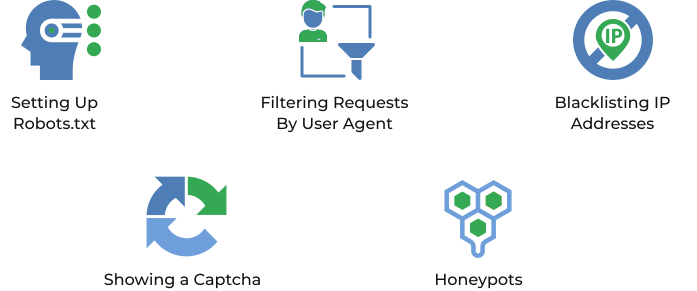
Detection today typically layers several methods together: bot detection scoring, CAPTCHA challenges, IP blocking, browser fingerprinting, and honeypot traps. Detection in modern systems is rarely a single-layer operation, each protection layer compensates for gaps in the others, which is precisely what makes bot detection difficult to defeat with a single simple countermeasure.
Here’s a closer look at the most common dilemmas.
Web Scraping Challenges and Solutions: Enterprise Bot Protection Cloudflare, Akamai, Imperva, DataDome, PerimeterX
Imperva and Akamai were early leaders in bot detection and content protection. Today, Cloudflare Bot Management, DataDome, and PerimeterX are just as common, particularly on sites that get scraped often enough to justify the investment. In independent testing of nearly 17,000 popular domains, advanced anti-fingerprinting bots were blocked by only about 7% of targets, so most organizations remain highly vulnerable to proper scraping despite having some protection in place.
These systems distinguish real visitors from crawlers using bot scoring, request pattern analysis, and increasingly, AI-based behavioral modeling. Well-built scrapers today can simulate human behavior convincingly enough to get past a meaningful share of these defenses. Still, doing so consistently across many sites is a specialized skill rather than a default capability.
Browser Fingerprinting
Beyond IP and request-pattern checks, modern anti-bot systems inspect the browser itself. Canvas rendering, WebGL output, the navigator.webdriver flag, and TLS handshake signatures (JA3 fingerprinting) all leave a detectable trace that a standard headless browser doesn’t hide by default. A scraper can pass all the previous checks but still get banned because of a fingerprint mismatch.
Addressing this requires: fingerprint patching (tools like playwright-stealth or anti-detect browser infrastructure for high-volume projects) configured specifically to the target site’s detection layer.
CAPTCHA resolving challenge
CAPTCHA requests are designed to separate humans from crawling tools, using logical puzzles or character-recognition challenges.
Solving them has gotten easier through open-source tools and CAPTCHA-solving services, but all cases are different. CAPTCHAs on some Chinese-language sites, for instance, are difficult even for humans; DataOx has specialists who solve these manually to guarantee smooth passing.
IP blocking challenge
IP blocking is another common method to fight against scrapers. It works when a website detects lots of crawling attempts from the same IP address or when the requests are coming from IP addresses already registered in the blacklists. There is also IP blocking through geolocation when a site is protected from attempts from certain locations.
The standard fix is: proxy rotation, but the type of proxy also matters.
- Datacenter IPs are the cheapest and fastest to acquire, but they’re also the most heavily flagged because legitimate human traffic rarely originates from cloud hosting ranges.
- Residential proxies, tied to real ISP subscribers, carry a cleaner reputation.
- Mobile residential proxies go further still, since they’re identical to smartphone traffic on a carrier network.
Which tier makes sense depends on how aggressively the target site is protected: datacenter proxies are fine for lightly protected sites; enterprise-grade bot management requires residential or mobile IPs.
Honeypot Traps
Some sites embed invisible links or form fields on a page. It is invisible to a human visitor, but present in the raw HTML and therefore visible to a scraper. Following one of these “honeypot” links or filling a hidden field is an instant signal that the visitor is a bot, and it triggers an immediate block.
Such traps should be recognized by: hidden elements via CSS (display:none, zero opacity, off-screen positioning) and carefully avoided.
Common Web Scraping Challenges and Solutions: Large-Scale and Real-Time Scraping
When parsers are constantly monitoring web pages for changes, any instability in the pipeline can cause breakdowns. One failed request in a long chain can stall an entire real-time data collecting.
Keep this kind of system to constantly handle real-time scraping:
- retry logic;
- monitoring for silent failures’
- a proper infrastructure that can handle burst of concurrent requests.
Web Scraping Challenges and Solutions: Data Quality and Duplicate Data
The same listing, article, or product can appear multiple times across different URLs or pagination states, and without deduplication logic, that repeated data ends up in the final dataset. Running a proper quality assurance pipeline before data delivery is the only reliable way to prevent this.
Such pipeline should include:
- validating every field;
- checking for duplicate records;
- flagging anomalies.
Some of this can be automated; some needs manual review, particularly for complicated cases.
How DataOx Handles Challenges in Web Scraping
Every challenge above is one DataOx deals with routinely. Proxy rotation across datacenter, residential, and mobile tiers; fingerprint patching; CAPTCHA solving, including manual checks for the hardest cases — all of this is built into how we set up our projects. Structural change detection and scheduled maintenance keep pipelines running as target sites evolve, and every delivery goes through a data quality pass before it reaches a client.
If a specific site is causing troubles for your current scraper, schedule a free consultation with our team — we’re happy to look at what’s actually blocking you and scope the right fix.

web scraping services
Get free consultation
FAQ for Web Scraping Challenges
What are the most common web scraping challenges for businesses?
The most frequent ones are website structure changes, anti-bot protection (CAPTCHAs, IP blocking, browser fingerprinting), JavaScript-rendered content, and data quality issues like duplicates or missing fields. DataOx scopes every project around the specific challenges a target site presents; we have prepared solutions, yet we constantly develop custom workarounds for specific cases.
How do websites detect and block web scrapers?
It happens because of several methods: IP reputation and rate-limit tracking, CAPTCHA challenges, browser fingerprinting (Canvas, WebGL, TLS signatures), and behavioral analysis that flags non-human request patterns. Enterprise-grade protection from vendors like Cloudflare, Akamai, Imperva, and DataDome combines multiple layers simultaneously. DataOx runs a detection audit on a target site before building a scraper, to establish which layers are active and should be solved.
How do I handle websites protected by Cloudflare, Akamai, or DataDome?
Each of these vendors checks different signals, so there’s no universal bypass. DataOx starts with a detection audit to establish which specific protection layers are active on a target, then builds the scraper around that: proxy tier selection, fingerprint patching, and request pacing that is appropriate for site.
Why did a working scraper suddenly crash overnight?
The most common cause is a change on the target site (a redesigned page, a moved element, or a new anti-bot check added without notice). Scrapers built around specific CSS selectors or XPath expressions are vulnerable for such changes. Additional causes are: scheduled maintenance windows on the target site, IP blacklisting from accumulated request volume, an expired session token. DataOx recommends checking the site manually first to understand if the page load normally in a browser or if the selector still exists. Usually, it significantly reduces the problem.
Why does the script return empty HTML or missing fields?
This almost always points to content that loads after the initial page request, through JavaScript. A plain HTTP request captures only the raw server response, so if the data you’re after gets rendered (a price that completes after an API call, a listing that appears with a scroll) the scraper’s request won’t see it at all. DataOx recommends switching to a headless browser that executes JavaScript before parsing. If individual fields are missing, it is more often a sign the site changed its structure and the field’s selector no longer matches anything.
Stay ahead with data insights
Subscribe to DataOx newsletter




get a free consultation
Fill out the form — we'll get back to you with options tailored to your needs.
what happens next
We review your goals and get in touch to clarify scope
Your privacy is a priority — NDA available upon request.
You receive a clear proposal with timeline, budget, and delivery format.
Once approved, we start building your data pipeline.


contact us
Let's find the best solution for your data needs.

get a free consultation
Fill out the form — we'll get back to you with options tailored to your needs.
what happens next
We review your goals and get in touch to clarify scope
Your privacy is a priority — NDA available upon request.
You receive a clear proposal with timeline, budget, and delivery format.
Once approved, we start building your data pipeline.
contact us
Let's find the best solution for your data needs.