Back to blog
Data Parsing: 5 Use Cases That Save Time and Money


Data Parsing Meaning in Every Industry
The importance of information increases every day, and the demand to extract, read, and analyze it grows along with it. Today, it is impossible to imagine a business world without Big Data. In nearly every industry, information is the principal driving force for business growth. But not all content extracted from online sources is readable. That’s where data parsing comes to the rescue.
In this article, we’ll learn what parsing is, what a parser does, the use cases of data parsing, and other interesting facts.
What is Data Parsing?
When you extract content from web sources, the next step is content parsing or converting information into an understandable and readable format. The point is content extraction provides content in raw HTML format, which is not possible to read and understand. Therefore, it should be converted into an accessible and readable format.
What is a Data Parsing Tool?
What is meant by parsing? Let’s define it. While parsing, every single string does not need to be converted, and a well-built parser can identify required information, select it, and convert it into CSV, JSON, or table format.
So, what is the meaning of parse? To parse means to analyze a text or string into syntactic components, and a parser is a program that is used to decompose and transform content into a readable format for further processing.

Generally, a data parser is a software program that executes the process of parsing but to be more specific, the parser also analyzes tokens produced by the lexer. Thus, the parser takes care of the most significant part of parsing, and the lexer takes the role of assistant. A parser produces a structured insight from the code in the form of a tree known as a syntax tree. It is called a tree because it comprises different levels.
Data Parsing Tool: Structure
A parser is composed of a lexer (also known as a tokenizer) and the proper parser. First, the lexer inspects the content and breaks it into tokens. Then the parser inspects the tokens and produces a syntactic analysis. A lexer and a parser work in that order.
The proper parser takes care of the structure of the content, makes a syntactic analysis, and creates a parse tree. A parse tree or syntax tree is an ordered tree with the syntactic structure of a string.
What is Data Parsing: The Process
Data parsing involves two steps: lexical analysis and syntactic analysis.
Lexical analysis
Lexical analysis is a primary step of parsing wherein the allocation of collected data structures takes place before execution.
Syntactic analysis
Syntactic analysis is the second step. The allocated data is executed based on the parser’s pre-written code and structured data.
Types of Data Parsing
There are two parsing methods: top-down and bottom-up. They mainly differ in the order in which the nodes of the parse tree are generated.
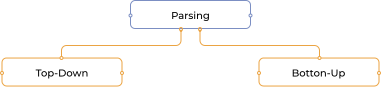
Top-down data parsing
A top-down parser starts parsing at the first symbol of the syntax, identifying the root of the syntax tree before moving to the bottom.
Bottom-up data parsing
A bottom-up parser starts parsing the content back to the start symbol, up from the root of the tree, as it tries to find the right source of a current string by moving backward.
Best Web Scraping and Data Parsing Tools: Methods of Building
Because of the flexibility of data parsers, they can be used with various technologies:
- Scripting languages used in games, multimedia, web applications, plugins, and extensions.
- Modeling languages used by system analysts or developers to understand system requirements, behaviors, and structures.
- HTML for web page and web application creation and XML for transforming information between websites and web applications.
- Interactive data language is used for the interactive processing numerous information.
- SQL programming language for content management.
- HTTPS and Internet Protocols are responsible for data communication across the web.
Parsing in Programming
Parsing is widely used in top-level programming languages. A string of commands is separated into components, which are then analyzed for proper syntax and linked to tags defining each component. This process comprises parse meaning in programming.
Let’s consider a very simple example: if you break down the sentence into parts (verbs, nouns, prepositions), you would parse the sentence, thus transforming one form of data into a data structure.
Implementing Parser
As we said, a parser is used to transform content into a syntax tree, which represents the hierarchical order of the elements. A parser is fundamental in the following applications:
- Google or Bing parses content from downloaded webpages with crawlers, and the parsed information is used for browsing.
- XML parsers take care of analyzing XML documents and preparing their content for further use.
- HTML code is a string of symbols for a computer that should be analyzed by a parser and later provided as structured content.
- The reading of programming code is executed by a parser that delivers a data structure to the language processor to generate machine code.
Read more on related topic here —> Document Scraping and Parsing Solutions
Why Data Parsing Matters
Thanks to parsing, it is possible to identify the structure and extract the content. It is a necessary process, as different programs need data in relevant forms and parsing enables you to transform content to be understood by specific programs as in the case of software programs that are written by humans but executed by computers.
Consequently, people write programs, so they can understand them, but software programs transform them so that computers can understand them.
Data Parsing vs Data Collection
Web scraping needs parsing to transform content with irrelevant information into a structured and readable format. This is required for making a proper analysis and providing accurate results. Data parsing follows right after web scraping, where the purity of extracted content will define the results after analysis.
Discover basics about data collection workflow —> Scraping Basics: Challenges & Solutions for Companies
Outsourcing vs Building Your Own Data Parsing Tool
This question concerns everyone who is faced with the parsing issue. The answer depends on whether you’re a big company with a lot of resources to build and maintain a parser, or a small or medium business that needs a parsing solution to stay competitive and grow within the market.
How about investigating the pros and cons of both options?
Pros of an in-house data parser
- + You have control over the planning, development, and testing
- + You have a parser under your requirements and can be updated upon necessity.
Cons of an in-house parser
- – You need to hire and control a development team.
- – You need to buy a strong server for your needs.
- – As a rule, building a parser is more expensive than buying.
- – Occasionally, maintenance is compulsory, and it will require more expenses and more time.
Pros of outsourcing a parser
- + No need to spend money on the hiring team; everything is taken care of by your supplier.
- + All issues are solved by professionals who are familiar with their technology.
- + You get a fully tested parser checked against your requirements.
- + You won’t need to worry about controlling and making decisions, thus saving you time.
Cons of outsourcing a parser
- – Buying is normally less expensive.
- – Your control over the whole working process is limited.
Data Parsing Meaning for Business: Use Cases
Parsing allows for more efficient use of information, which is necessary in today’s business world. Let’s consider several ways businesses apply parsing, along with the advantages each one offers.
Streamline workflow
By transforming unformed content into an understandable format, organizations can optimize their workflow, particularly its effect on the performance of programmers, data analysts, and marketers.
Enhance recruitment
With the help of parsing tools, HR specialists will be able to scan hundreds of resumes per day. Depending on your industry, your candidates may have a variety of data points that should be analyzed and considered.
Of course, manual processing will take a lot of time, and thanks to a dedicated resume parser, your HR department’s efficiency will increase substantially.
Data modernization
With the help of parsing, you can forget about out-of-date formats that are hard to decipher. By using the right parsers, your content will be safe while transforming into a more usable format.
Investment analysis
Before any investment, data analysis is a compulsory requirement; evaluating earning, forecast or competitive analysis demands time and substantial data. That’s why data analysts and investors are practicing parsing to get better insights for making their final decision.
Saving time and money
Once you have the right parsing solution, getting valuable insights for your business needs becomes more efficient. Although it will cost you some initial investments, in the long run, you’ll save time and money.
DataOx’s Approach in Parsing: Custom Solution
Now that you have a better understanding of parsing, you know how it can be used and when. If you need to parse a huge amount of information, you’ll either have to hire a team of developers or buy a parser in compliance with your business requirement.
At DataOx, we are always ready to help you with sophisticated parsing solutions or advice. Schedule a free consultation with our expert to learn how to get proper data analysis and valuable insights.

web scraping services
Get free consultation
FAQ about Data Parsing
What is data parsing?
Parsing is the process of collecting data, processing it, and analyzing it. This method is used when it is necessary to process a large amount of information that is difficult to handle manually. Data parsing always follows web scraping in the pipeline, and DataOx handles both services so clients receive clean, structured output in preferred format.
What is a data parser?
A parser is a program for collecting and organizing information posted on various sites. The data source can be text content, website HTML code, headings, menu items, databases, and other elements. DataOx builds custom parsers as part of scraping projects, configured to the specific structure and field requirements of each target source.
How to parse data?
The parsing process is the syntactic analysis of any set of related data. In general, parsing is performed in several stages:
1. Scanning the initial array of information (HTML code, text, database, etc.).
2. Isolation of semantically significant units according to given parameters – for example, headings, links, paragraphs, fragments in bold type, and menu items.
3. Converting the received data into a format convenient for studying, as well as their systematization in the form of tables or reports for further use.
For projects where the source structure changes frequently or data quality needs ongoing validation, DataOx maintains parsers and adjusts them when target pages update their HTML.
What are the best web scraping and data parsing tools for non-developers?
The most accessible no-code options are ParseHub, Octoparse, and Import.io — they let users set up extraction templates visually without writing code. However, for cases with JavaScript rendering, anti-bot protection, or if project requires output in a custom format, the best web scraping and data parsing tools are either a Python-based stack (BeautifulSoup, Scrapy, Playwright) or a fully managed service. DataOx builds custom parsing pipelines for clients whose data requirements go beyond the range of ready tools.
What is the data parsing meaning in the context of resume and HR data processing?
A resume parser reads CVs submitted in PDF, DOCX, or plain text, identifies fields like job title, skills, education, and employment dates, and outputs them in a structured format that an ATS or spreadsheet can process. Without parsing, HR teams manually copy data from hundreds of documents, and this process is both slow and prone to errors. The same principle applies to any workflow related to documents: legal filings, financial reports, government datasets. DataOx has handled document parsing projects across HR, legal, and financial industries, including sources where inconsistent formatting required custom field recognition logic and data visualization.
Stay ahead with data insights
Subscribe to DataOx newsletter




get a free consultation
Fill out the form — we'll get back to you with options tailored to your needs.
what happens next
We review your goals and get in touch to clarify scope
Your privacy is a priority — NDA available upon request.
You receive a clear proposal with timeline, budget, and delivery format.
Once approved, we start building your data pipeline.


contact us
Let's find the best solution for your data needs.

get a free consultation
Fill out the form — we'll get back to you with options tailored to your needs.
what happens next
We review your goals and get in touch to clarify scope
Your privacy is a priority — NDA available upon request.
You receive a clear proposal with timeline, budget, and delivery format.
Once approved, we start building your data pipeline.
contact us
Let's find the best solution for your data needs.