Back to blog
Why Choose Cloud Web Scraping over Local: Pros & Cons


Cloud Data Extraction as a Tool
Web scraping has become an essential tool in e-commerce, marketing research, consumer sentiment analysis, and even in politics and crime detection. So, with the growing demand for web scraping services, much is said about cloud web scraping, particularly in the context of real-time data extraction.
Let’s understand how you can benefit from cloud data extraction and highlight the difference between a power automate cloud web scraping and a web scraper as a browser extension.
Web Scraping: Cloud Option Facts
Web scraping can be performed in 3 major ways: through desktop applications, browser extensions, and cloud-based services.
People say that cloud-based scraping solutions are the most flexible ones, and the following facts make it clear:
- Reduced risk of network interruptions
- Cloud-based services are independent of OS.
- Collected insights are saved in the cloud and can be accessed at any time.
- Thanks to IP rotation proxy, the risk of being blocked by target websites is significantly reduced.
- There is no need for high-cost hardware and maintenance.
Cloud-Based Web Scraping: Variety of Features
Proxy rotation
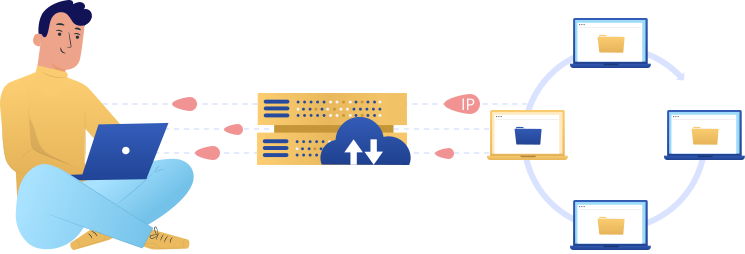
Proxy rotation is used to access the website from a non-restricted location and prevents scrapers from being blocked. Thanks to a proxy server, a new IP address is assigned to a scraper for every connection.
This is critical, especially in the case of a large-scale scraping. So, when you need to send over 1000 requests to various websites, you do it from 1000 various IP addresses, thus preventing scrapers from being detected and blocked by anti-scraping measures.
Scheduler
A scheduler is another important feature that enables scheduling and automating scraping sessions for a certain period on a daily or hourly basis.
Parser
A parser is used to automate data post-processing to provide accurate and clean content. With parser as a power automate cloud web scraping, you will be able to delete/replace strings or columns with a few clicks instead of doing it manually.
Exporting data
A cloud web scraper enables the export of content in XLSX, JSON, and CSV formats, while a web scraper browser extension exports data only in CSV format.
Pros & Cons of Cloud-Based Web Scraping
To be entirely informed, let’s discover what are the pros and cons of cloud-based scraping.
Pros:
- A cloud-based service can be used on any browser and any OS.
- No need to host anything yourself, everything is done in the cloud.
- There is no need to manage web proxy requirements.
- Cloud solutions are accessed and run without any special software programs
- installed on your PC; the only thing you need is internet access.
Cons:
- You may still encounter scraping restrictions applied on target websites.
- In case your data scraping needs grow, your monthly fees will grow correspondingly.
- Complex websites, where AJAX or JavaScript are used, usually cause difficulties for cloud solutions.
- Data security can be an issue.
Real-time Data with Cloud Data Extraction
If you are hunting real-time data from regularly updated resources like e-commerce sites and social networks, then it is better to use a cloud web scraper.
By gathering information up-to-the-moment you will be able to handle timely content analysis and comparison, thus collecting valuable insights about your competitors, customers, and market. Business strategies based on real-time insights will provide you with:
- The increased website traffic and engagement
- New lead generation opportunities
- Better online reputation
- Enhanced brand awareness
- Improved sites’ ranking
- Increased sales
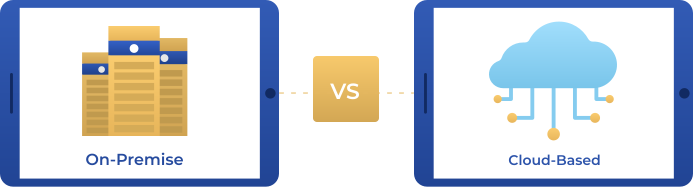
The Difference Between a Web Scraper Cloud-Based and a Web Scraper as a Browser Extension
| Cloud Web Scraper | Browser Extension Web Scraper |
|---|---|
| Consistent stability and website accessibility while scraping. | Limited access. You can scrape only websites accessed via the browser. |
| Thanks to IP rotation proxy, the chance of getting blocked is small. | Special tools to overcome the anti-scraping mechanisms should be applied. |
| Scraped data is saved in cloud storage. | Information is saved in the local storage. |
| Images are not loaded during the scraping process. | Images are loaded while scraping. |
| Data exported in XLSX, JSON, and CSV formats. | Data is exported in CSV, XML or Excel formats. |
Final Statements About Cloud Data Extraction
We have already understood how cloud-based web scraping can help you in your business development. It provides you with new opportunities through near real-time data analysis. At DataOx we are always happy to offer various cloud-based scraping options to our clients meeting their business needs both financially and technically.
Schedule a free consultation with our expert and find out how the DataOx team can help your business grow through cloud-based web scraping.

web scraping services
Get free consultation
FAQ about Cloud Web Scraping
What is cloud web scraping and how does it differ from desktop or browser-based scraping?
Cloud based web scraping runs on remote servers without local installation, OS dependency, or hardware requirements. In turn, browser extensions scrape only what the browser accesses and save data locally. Desktop scraper applications depend on the computer they run on. Cloud data extraction operates independently of all three hurdles, extracted data is stored remotely and accessible at any time. DataOx builds cloud scraping solutions adapted to the client’s technical environment and data volume requirements.
What are the main advantages of cloud data extraction over a browser extension?
Stability, scale, and format flexibility — these are main practical differences. A cloud web scraper provided by DataOx maintains consistent access, rotates IP addresses automatically to avoid blocks, and exports data in XLSX, JSON, and CSV formats plus custom ones. A browser extension has limited range of formats, loads images during scraping, and cannot bypass anti-scraping mechanisms without using special tools. For serious data collection needs, the gap between these two options is significant.
What is proxy rotation and why does it matter in web scraping cloud infrastructure?
Proxy rotation assigns a new IP address to the scraper for every connection request. Considering that scale can require 1000+ requests to various websites, proxy rotations prevent detection and blocking by anti-scraping systems. Without it, large-scale extraction gets interrupted or banned. Cloud based web scraping solutions by DataOx include proxy rotation natively, which is one of the reasons why it handles high-volume projects.
What are the real limitations of cloud based web scraping worth knowing before starting?
There are three limitations worth knowing: 1) monthly costs scale with data volume — larger scraping result in higher fees; 2) complex websites using AJAX or JavaScript present technical difficulties for standard cloud solutions; 3) data security requires attention, since scraped data passes through third-party cloud infrastructure. DataOx addresses all three difficulties directly: our custom solutions handle JavaScript targets, pricing is discussed per project, and data handling follows strict security standards.
When does real-time cloud data extraction make the most business sense?
When the target data changes frequently and time to make a decision is restricted. It can be applied to such niches as e-commerce pricing, social media sentiment, competitor inventory, market trend signals, and financial segment as well. DataOx configures update frequency per project: near real-time, hourly, or daily, depending on how unstable the target source is and what the business actually requires!
Stay ahead with data insights
Subscribe to DataOx newsletter




get a free consultation
Fill out the form — we'll get back to you with options tailored to your needs.
what happens next
We review your goals and get in touch to clarify scope
Your privacy is a priority — NDA available upon request.
You receive a clear proposal with timeline, budget, and delivery format.
Once approved, we start building your data pipeline.


contact us
Let's find the best solution for your data needs.

get a free consultation
Fill out the form — we'll get back to you with options tailored to your needs.
what happens next
We review your goals and get in touch to clarify scope
Your privacy is a priority — NDA available upon request.
You receive a clear proposal with timeline, budget, and delivery format.
Once approved, we start building your data pipeline.
contact us
Let's find the best solution for your data needs.